Returning Home to Some Toasted Cake

I made it back from my Palmyra adventure in one piece.  I’m a little tanner and lot tired, but it was a good trip.  I got a lot of science done, but equally important, I got a lot writing accomplished, too.  I guess that’s one of the advantages of not having much else to do on an isolated, tropical island.

While catching up on my email yesterday, I came across a message from Tina Connelly at Toasted Cake notifying me that the podcast of my story Clownspace was now available.  What a pleasant surprise! 

Clownspace is one of my favorite stories, primarily because it was so much fun to write.  Tina does an awesome job reading it, too.  I think it’s the best podcast of any of my stories, so pop over to Toasted Cake and check it out.  I also recommend the other stories at Toasted Cake—Tina is an excellent reader with a delightfully droll voice and wonderful sense of humor.  She also happens to pick fantastic material by some of speculative fiction’s best writers, including the likes of Ken Liu, Rachel Swirsky, and Kathleen Sparrow (to name only a few).

Posted in Science Fiction, Travel, Writing | Tagged , , | 2 Comments

Writing in the Swarm

I tend to squeeze my writing into the mornings, often before the sun come up.  This is especially true when the day job takes me traveling because the days are busy and tiring, and writing in the evening is generally not possible. 

This morning, I got up as I have the past week and made my way to a ramshackle affair affectionately known as the “Yacht Club” on Palmyra.  It’s quiet, sheltered from the rain, and I can watch the lagoon emerge from the night as daylight creeps in.  I fired up my laptop and started to work on my current story. 

Plink.

Flying things—white flies, termites, cockroaches, and the occasional mosquito—are frequent visitors to the Yacht Club.  This one is a small termite attracted to the light of my laptop screen.  I swipe it away.

PlinkPlink.

Hmm…  Two more, one of which bounces off my face before finding a landing zone on my screen.

PlinkPlinkPlink, plink, plink plink plink

Uh oh.  Termite reproductive biology follows a strategy wherein they launch a whole bunch—and I’m talking a whole bunch—of males and females into the night.  Mating occurs and the females set off to find a nice new patch of wood in which to start a new colony.  The males…let’s just say they aren’t so lucky.  Termites tend to swarm on humid and still nights, presumably because they are poor flyers.  They are attracted to any light brighter than the moon.  Yup, it was humid and still last night.  Yep, my monitor is brighter than moon, and it’s now crawling with no fewer than two dozen termites.  They’re also crawling on my legs and glasses, and I think one just went down my shirt.  Ack!

Good thing I’m not made of wood.

Posted in Travel, Writing | 5 Comments

Doubling Up

It’s been quiet around here recently because I’m still down in Palmyra and my time to write is limited.  With the limited time I do have, I’ve been focusing on writing stories rather than posting here, which is actually a good thing—I’m not going to build a successful writing career scribbling here.   

Since finishing the draft of that story that had me stuck, the flood gates have opened.  I’m working on two stories simultaneously.  That’s a rarity for me, and I’m not sure how it’s going to turn out.  I’ve had both story ideas for some time; I just wasn’t able to focus on them until now.  So far, I’m moving between the two stories with ease, writing a little each every morning.  A draft of one is almost done—maybe another couple of days and I’ll be there.  The other one still has a ways to go; I can tell, because the characters continue to reveal surprising new facets to me and the piece continues to evolve in my head.  For now, I’m going to continue to roll with it and post here as time and whim permit.

Posted in Travel, Writing | Leave a comment

Writing on the Run

My day job occasionally takes me to interesting places.  Most of these places are remote islands in the Pacific Ocean.  Currently I’m on Palmyra, a small atoll about 1000 miles south of the Hawaiian Islands.  It’s isolated by its distance from nearly everywhere (the closest “inhabited” island is Teraina, about 120 miles away, but it’s not exactly a booming metropolis).  Yet in this modern age, Palmyra isn’t really all that isolated—I have an internet connection.

While my work here involves long hours, I can generally squeeze some quality writing time into the dark hours before the sun comes up (I’m an early riser).  In fact, I’m writing this as the sky is just beginning to lighten and the sea birds are squawking their morning chorus.  Out the window are palm trees and the atoll’s lagoon, which will slowly shade from aquamarine to turquoise as the sun comes up.  Palmyra is a great place to write because the new surroundings and the quiet beauty awakens my mind and creativity.

The last few weeks, the words have been coming hard, and I’ve been stuck on a story.  However, I’m happy to say that I have finally finished the first, and hardest, draft—just this morning—and now I’m ready to put that on the shelf for a while and work on something new.  That will have to wait until tomorrow; my battery is running low and the coral reefs are calling….

Posted in Travel, Writing | 3 Comments

How Diverse am I?

This week, I’ve been thinking about the importance of diversity in science fiction and why science fiction needs to embrace diversity as a genre.  That got me wondering:  How much my fiction actually includes diverse characters and cultures?  So, I decided to go back through my stories and do some analysis. 

This isn’t a scientific assessment by any reach.  There’s a lot of subjectivity, but here’s what I did.  For each of my published or forthcoming stories (21 in total), I identified the gender, age, race, and socio-economic class of my protagonist, antagonist, and the significant supporting characters.  I selected one character to be the protagonist.  Not every story had an antagonist per se, but I tried to pick the one character who best filled that role.  I included only supporting characters that I felt played an important role in the story.  Defining a character’s the gender, age, race, and socio-economic class also wasn’t always easy.  For many characters it wasn’t defined or easily inferred from the text, so I designated these characters as “undefined.”

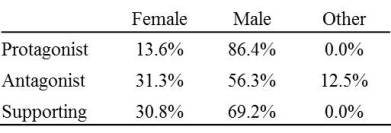
Gender: I was actually surprised to see that over 86% of my protagonists were male.  I’ve always thought that I wrote more women protagonist, but I the data don’t lie.  What I find interesting is that the percentage of woman as antagonist and support roles increases to 31%.  I’m not really sure what to make of this, except to say that I probably should have more women in my stories in general.  Finally, I had an “other” category, which included non-human characters.  I don’t tend to include many non-humans in my stories, but when I do, they are often the bad guys, it would appear.
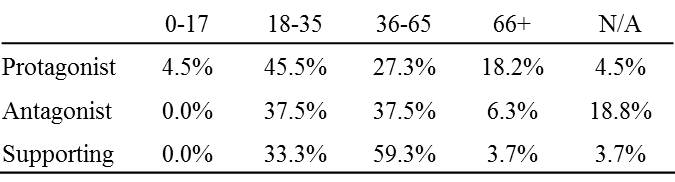
Age:  I divide ages up into somewhat arbitrary categories, but they illustrate what I want.  I actually had a fairly good spread of ages in all my categories with only children being under-represented.  This isn’t too surprising, because I don’t tend to juvenile or young adult stories.  I’m surprised that more children didn’t show up as supporting characters.  I assume this is an artifact of what I considered a significant supporting character, because children often play a key role in the motivation of my main characters.  I had more elderly characters that I would have thought.  The final category, which made up a surprising number of my antagonist (18%) included characters that either had no easily defined age or were ageless.
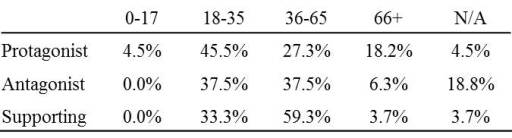
 Race:  I was pleasantly surprised to find so many races represented in my stories.  I’m not sure if I actually managed to accurately capture the individual cultures, but I hope I did.  The majority of my characters were still Caucasian, but groups like Pacific Islanders made up a significant percentage of my protagonists.  I’m pleased to see that my antagonists did not have a significantly different racial distribution.

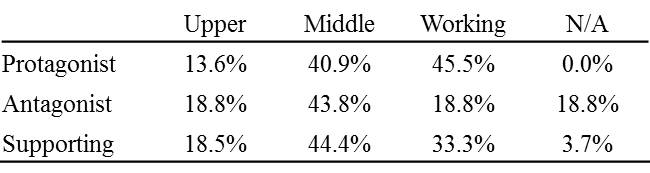
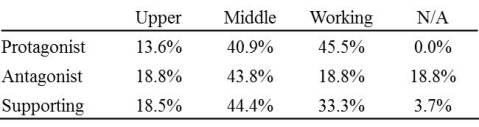
Socio-economic Class:  I don’t tend to write about rich people or the “ruling” class and that’s borne out in the data.  Nearly 87% of my protagonists fall in the middle or working class.  This pattern is also held (more or less) for my antagonists and supporting characters.
 So to sum things up, adult, white males comprised about 64% of my protagonists.  This is higher than I expected, and it’s also considerable greater than the percentage of adult, white, male antagonists (31%) and supporting characters (44%).  This analysis was eye-opening for me, and shows that I could do better bringing more character diversity into my stories, especially for my protagonists.

Posted in Science Fiction, Writing | Leave a comment

Questioning the Foundation

A few days ago, I wrote a post about diversity in science fiction—or more accurately the lack of it.  I realized after writing it that I simply accepted the premise that diversity is a good thing.  To be honest, I’ve never questioned this base assumption.  Yet, as a scientist, I’ve been trained to question everything, especially basic assumptions in an argument, because if these prove false, then every part of the argument built upon that foundation is potentially flawed.

Now before anyone gets bent out of shape, I think diversity in science fiction is desirable and important.  Not even considering the usual “politically correct” arguments, I think diversity is good for the science fiction because it will make the genre more vital and improve its survival prospects.  I see diversity in science fiction in the same way as I see genetic diversity in a plant or animal population.  In biology, high genetic diversity is usually associated with a decreased likelihood of extinction; genetic diversity gives a population the raw material needed for it to adapt to a changing environment.  For science fiction, the more diverse the people reading and writing it, the more likely it is to maintain its relevance in the face of a changing literary, social, and economic landscape.

Currently, there’s the perception that science fiction is a dying genre.  My Hopefull Monsters writing group has had numerous discussion about how many of the “big” magazines seem to be stagnant with the type of stories they publish.  This stagnation is likely the result of not enough diversity in writers and readers in the field.  After all, these publications must sell copies to stay alive, and probably can’t frequently forge into new territory without considerable risk, but that’s where I think smaller “indie” magazines can, and to some extent do, fill an important void.  I think expanding the diversity within the genre is crucial to keeping science fiction vigorous and relevant into the coming decades.

Posted in Science Fiction, Writing | 1 Comment

Diversity and Science Fiction: Too Many Middle-aged White Guys?

Recently, I’ve been thinking about diversity in science fiction (and I define this narrowly, meaning English-language science fiction).  This tends to be a touchy topic in many quarters, and for a while, I thought about not writing anything here.  I decided I wanted to post something, however, because I think it’s an important topic.  I’ll be up front with two things: (1) I don’t have the answers, just some opinions, and we all know what opinions are worth; and (2) while I’m certainly open to discussing the topic, I won’t let comments degenerate into ugliness (it’s my site; if you can’t respect that, stop reading and go post on your own site).

Right or wrong, science fiction has long been considered a field lacking diversity: middle-aged white guys writing about other white guys (I can say this, right, because I’m a middle-aged, white guy?).  While I believe the genre has become more inclusive over the past 20-30 years, I still think this is a fairly accurate assessment.  How many minority science fiction writers can the average reader name?  Probably not more than small handful (and likely several of them are no longer writing or even alive).  What about woman, science fiction writers?  Here they can probably do better—I know I can.  Minority, women science fiction writers?  Probably shouldn’t even try going there.

I’m sure there are many learned articles by smarter people than me examining the reasons behind this, but I haven’t read them.  I’m also sure this is a more complex issue than I imagine, encompassing aspects of socio-economics, culture and lifestyle that are beyond my learning.  That said, I’m going to make a simple observation: it seems to me that people who write science fiction, grew up reading it.  Those who didn’t read it, don’t tend to write it.  So perhaps that’s were the key lies?  Maybe the lack of diversity in the genre is a self-perpetuating artifact of the original writers, who tended to be middle-aged, white guys writing primarily for white, male audiences.

I read science fiction as kid because something about it spoke to me.  Was it the white protagonists?  I’m not sure that’s it, but I suspect having characters and cultures to which I could easily relate helped (I recall once struggle to read a fantasy novel set in a “fantasized” middle Eastern culture, but in hindsight, I’m not sure if it was the different culture or the book’s poor writing that challenged me).  I wonder if having a greater diversity of characters and settings in science fiction would attract a more diverse readership, eventually resulting in more woman and minority writers down the line. 

Assuming this thesis is true, then we potentially have a chicken-and-egg problem: if the field lacks diversity in its writers, who writes the stories with diverse characters and cultures that will attracted diverse readers?  I know some people would disagree, but I think a lot of fine writers can write convincingly about different people and cultures.  (Of course, this is no substitute for people of diverse cultures writing about their culture.)  Science fiction writers need to embrace the diversity out there, do their home work, and most importantly not be afraid to write stories outside their cultural comfort zone.  This is no small challenge, given the perception by some that only minorities can understand and write about the minority condition (I don’t necessarily subscribe to this line of thinking).  This might be the only way to break the cycle and ultimately bring more diversity to the genre.  Like diversity in nature, diversity in science fiction would be a good thing, and it may help increase the genre’s vitality and readership.

Posted in Science Fiction, Writing | 15 Comments

Inspiration: “Hoodoo”

For those of you who follow my Scribbles, you know that one of the most common questions I get asked about my stories is where did I get the idea for it.  People seem to be endlessly fascinated by the creative process, particularly for speculative fiction.

“Hoodoo” had it’s genesis in a brainstorming session with my writing group, Hopefull Monsters.  About two years ago, Colum Paget, a big idea man and excellent writer, suggested we all submit a story to Dagan Books’ acheologically-themed anthology, IN SITU.  The idea for the central artifact in “Hoodoo” came to me during our group brainstorming exercise and evolved out of an initial idea that the artifact was a message in a bottle.  I won’t say more because I don’t want to give away too much.  The setting and title were inspired from a trip I took to Goblin Valley in the southwest United States (oh so long ago).  Ever since that trip, I’ve wanted to set a story in a place like Goblin Valley, and I finally found the right tale.

“Hoodoo” can found in the debut issue of Specutopia, which is available for purchase in Kindle, Nook, and other formats.

Posted in Inspiration, Writing | Tagged , | Leave a comment

Close…Again

I don’t ordinarily say much about story rejections—they’re part of the writer’s life—but this one is a special case.  I’ve consistently submitted to Writers of the Future over the years.  It’s perhaps the most prestigious writing competition for amateur speculative-fiction writers and open to people who have published fewer than four pro-rate stories.  With recent sales to Daily Science Fiction and Lightspeed Magazine (my fourth and fifth pro-rate sales, respectively), my eligibility is winding down—as soon as one of them is published, I’ll be disqualified from Writers of the Futures.

My string of near-misses continues in the contest.  I receive news last night that my latest entry for Quarter 2 received a semi-finalist.  For those not familiar with the contest format, out of the 1000+ entries every quarter, 8 finalist and 5-10 semifinalist are selected, so my story finished in the top 15 or so, but not actually high enough to continue to the final judging (3 of the finalist will be selected as winners for the quarter).  This is the fourth time I’ve placed a story as a semi-finalist, to go along with one time as a non-winning finalist.  Not bad considering I’ve entered only about a dozen times.   While I’m pleased to get close again, but I must be honest and say I’m also disappointed.  I’m tired of getting close.

I figure I’ve got two—maybe three—more  chances before I’m official disqualified.  Maybe my next one will be a winner…so says the optimist in me….

Posted in Writing | Tagged , | 2 Comments

Ack! My Short Story has Grown Too Fat!

A couple of months ago, I set out to write a 5,000-word short story.  As I sat down to write today, I found that my short story had grown toward novella proportions: 13,500 words and counting.  This is a problem. 

I know I often write “long” on first drafts.  Generally between my first and second draft I trim between 30-50% of the original words (which I consider a lot of throat clearing).  The final story will usually have half the word-total I started out with.   So why does the 13,000+ words for my current story-in-progress bother me so much?  I think I’ve gotten good at estimating before I start how long a story should be in the final form, so when I set out writing the current story-in-progress, I thought I had a 5,000-word story.  I still think I have a 5,000-word story. 

Clearly I don’t have a handle on my story-in-progress.  I’m wandering around aimlessly, probably because there is something in the story I have yet to figure out.  I’m not sure what it is, however.  I think I understand the characters.  I think I understand the conflict and theme I want.  The setting, too.  I think I know where I want the plot to go.  At least I think I understand all of these.  Obviously, I don’t.

I’ve found from past experience that I am not the type of writer who can write himself out of corner—it’s simply not an effective way for me to write.  So what do I do?  That’s a good question, because I want to write this story, and I’m finding it difficult to drop it and switch to something new.  It’s a good story idea, and one I want to tell, so I’ll give it a little more time, a little more wandering, and see if I can find my way.  Otherwise, this one will have to go on the shelf for a while.

Posted in Writing | Tagged | 6 Comments